
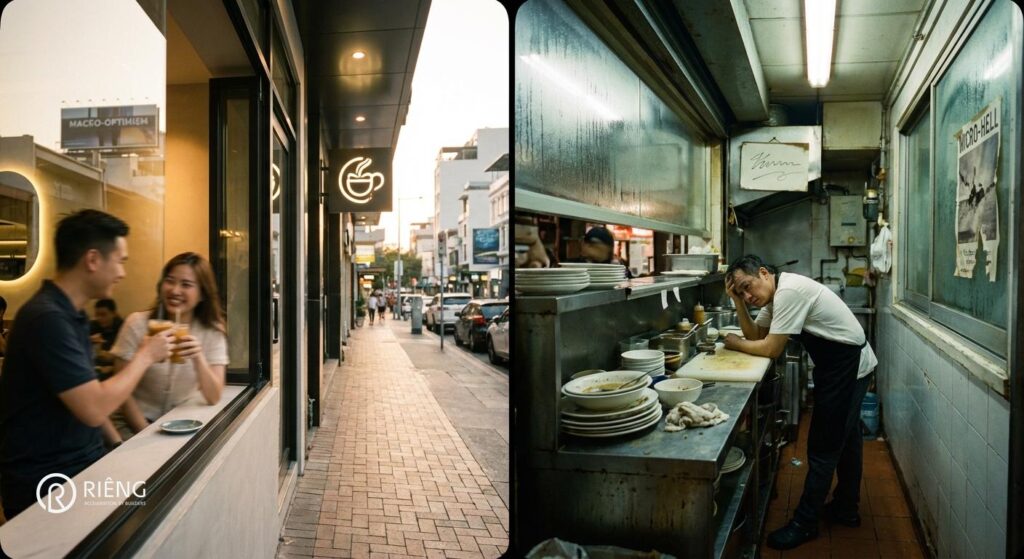
The Macro Mirage: Why Your Feasibility Study is Wrong
If you are reading English-language investment reports from Singapore or Hong Kong, Vietnam looks like the promised land. The metrics are intoxicating. You see a population of 100 million, a rapidly urbanizing middle class, and a GDP growth projected to hit 7.5% to 8.5% through 2030.
The narrative is linear and seductive: “Vietnam is the next China. Get in now.”
Yet, if the market is so robust, why are giants like McDonald’s and Burger King still struggling to gain traction after a decade of operations? Why did 2024 and 2025 see the “quiet exit” of major regional players like Café Amazon?
The answer lies in Information Asymmetry.
There is a dangerous gap between the sanitized data presented in English prospectuses and the gritty, operational reality on the streets of Ho Chi Minh City and Hanoi. While macro-economists look at GDP, local operators are looking at a “survival of the fittest” purge. If you enter 2025 blind to this asymmetry, you aren’t investing. You’re gambling.
1. The English Media Echo Chamber
Open any standard market entry report from 2024, and you will see the same bullish bullet points. They cite the “golden demographics” where 70% of the population is under 40. They forecast the F&B market to reach nearly $37 billion by 2027. They speak of a “post-pandemic recovery” and a “vibrant consumer class.”
What these reports fail to mention is the carnage occurring underneath the headline numbers.
In the first half of 2025 alone, Vietnam witnessed the closure of over 50,000 F&B establishments. This wasn’t a gentle correction. It was a mass extinction event representing a contraction of over 7% of the total market. While English media highlights “potential,” the Vietnamese press is dominated by headlines about the “open fast, close fast” phenomenon. New concepts burn through their capital in three months and vanish.
2. The “Silent Killers” (What the Local Papers Say)
To understand why businesses are failing despite GDP growth, we had to dig into the Vietnamese vernacular search results. We found two structural “killers” that foreign investors rarely factor into their P&L until it is too late.
The Real Estate Paradox: Skyrocketing Rents in a “Ghost Town”
A phenomenon currently sweeping central districts is the làn sóng trả mặt bằng, or the “wave of premise returns.” You would assume that record vacancies would drive rents down. In Vietnam, the opposite is happening.
Landlords are refusing to lower rents. They choose to leave prime locations empty for months or years. Under the new Land Law 2024, land valuations have shifted to market-based pricing. This drastically increases the holding costs and taxes for property owners. Furthermore, many landlords use these properties as collateral for bank loans. Lowering the rental price would devalue the asset and trigger margin calls from their banks.
The Regulatory Purge: The PCCC Crisis
The most brutal shock of 2024 and 2025 has been the crackdown on Fire Prevention and Fighting (PCCC) regulations. Following a series of tragic fires, the government enforced QCVN 06:2022/BXD retroactively.
This detail is missing from most “Ease of Doing Business” brochures. Thousands of karaoke bars, clubs, and restaurants were suspended overnight. Foreign investors often lease converted villas or older shophouses for their aesthetic appeal. They only find out after signing the lease that the building cannot structurally meet the new fire codes, such as requirements for external staircases or pressurized smoke lobbies. In Hanoi alone, over 1,100 venues were suspended in a single sweep.
3. Why 2025 is a “High Risk” Entry Point
The market of 2019 is gone. 2025 represents a “compliance cliff” that creates a hostile environment for new entrants who are not hyper-prepared.
- The End of the “Grey” Economy: Starting mid-2025, the government mandated the use of e-invoices generated directly from cash registers for F&B businesses. This forces 100% revenue transparency. It effectively kills the “tax optimization” strategies that many local competitors used to survive on thin margins. While this levels the playing field legally, it creates a short-term shock where operational costs for compliant businesses skyrocket.
- The “Zero Tolerance” Revenue Hit: The strict enforcement of the 0.0% blood alcohol concentration limit for drivers has permanently altered dining habits. Beer sales, which are often the highest margin item for casual dining, plummeted by double digits in recent years. Even giants like Heineken had to pause operations at major breweries. If your business model relies on alcohol sales to subsidize food costs, your model is broken before you open the doors.
- The “Foreigner Tax”: Information asymmetry breeds corruption. Foreign-owned businesses are often targeted for “unofficial” fees by local inspectors. These range from food safety checks to sidewalk encroachment fines. Without a local partner to navigate this “facilitation” culture, these hidden costs can bleed a P&L dry.
Conclusion: Don’t Guess. Audit.
Vietnam remains a market of immense potential, but the “low-hanging fruit” has been eaten. The failures of 2025 prove that you cannot enter this market using Google Translate research and macro-economic hope. The gap between what you think is happening and what is actually happening is the Information Asymmetry. That is where capital goes to die.
Ready to see the real numbers?
Stop guessing. You need an audit of the ground reality, not a summary of GDP forecasts. We bridge the gap between English expectations and Vietnamese reality. Contact us today for a Market Feasibility Audit that exposes the hidden costs, regulatory traps, and real estate risks before you sign a single lease.
References
In Vietnam, ‘feeding the police’ just a cost of doing business | Corruption | Al Jazeera
E-Invoice Compliance in Vietnam: Key Requirements & Best Practices
Rising land prices present new challenges for Việt Nam’s real estate sector