
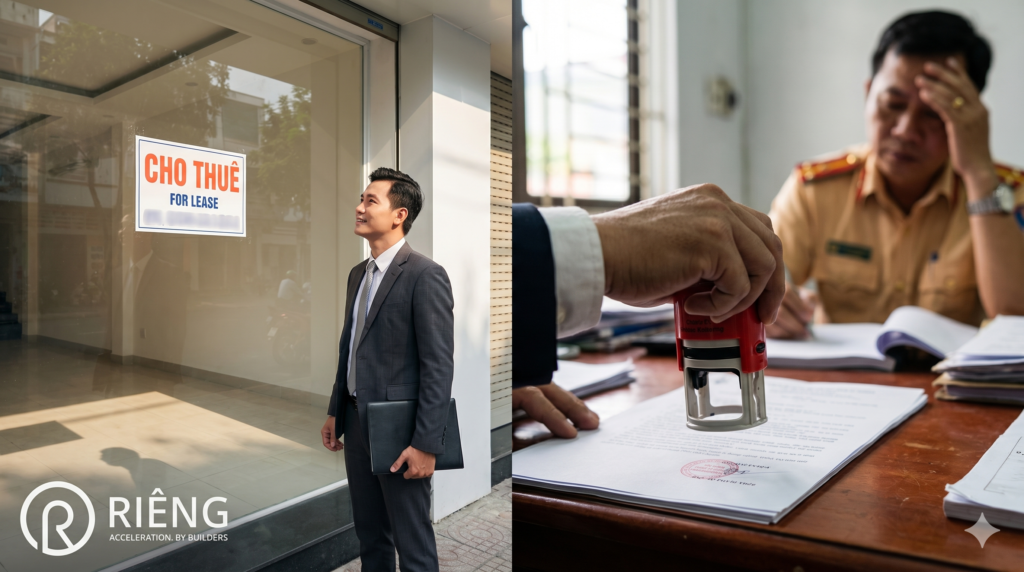
You have found the perfect location for your new restaurant in Vietnam. The rent fits your budget. The foot traffic is great. You are ready to sign.
Then you hit the wall.
The Department of Planning and Investment (DPI) tells you that you cannot submit your dossier for an Investment Registration Certificate (IRC) without a signed lease agreement or a binding MOU.
You go back to the landlord. They tell you they cannot sign a lease with a company that does not exist yet. They want a company stamp and a tax code on the contract.
This is the classic “Chicken or the Egg” deadlock. The government wants the lease to give you a license. The landlord wants the license to give you a lease.
If you read standard legal guides from firms like LexConsult or ASL, they will correctly list the “Lease Agreement” as a mandatory document. However, they often skip the most important part: how do you sign a lease for a ghost company?
If you are stuck here, do not panic. This is a standard hurdle in Vietnam market entry. There is a legal way to solve it without putting your personal savings at risk.
1. The Amateur Mistake: The “Personal Name” Trap
When faced with this deadlock, most first-time investors make a quick, emotional decision. They just sign the lease under their personal name to “get it done,” planning to switch it to the company later.
This seems harmless, but it creates a financial nightmare.
According to Vietnam’s strict tax laws (specifically Circular 96), business expenses are only deductible if the invoice strictly matches the company’s details. If you pay three months of deposit and your first month’s rent as “Mr. John Smith,” your future company cannot claim that money as a valid business expense.
The Math of the Mistake:
Let’s say your rent and deposit total $10,000.
- Lost VAT Credit: You lose the ability to claim back the 10% VAT ($1,000).
- Higher Taxable Income: Because you cannot deduct this $10,000 as an expense, your company’s profit looks $10,000 higher on paper. You will pay 20% Corporate Income Tax (CIT) on that phantom profit ($2,000).
By signing personally, you have effectively paid a 30% penalty on your startup capital before you have even served your first customer.
2. The Legal Hack: The “Pre-incorporation Contract”
You do not need to sign as a confused individual. You need to sign as a Founder.
Vietnamese law has a specific mechanism for this exact situation called the Pre-incorporation Contract (or Hợp đồng trước đăng ký doanh nghiệp).
This right is protected under Article 18 of the Law on Enterprises 2020.
The Mechanism:
Article 18 explicitly allows a founder to sign contracts that serve the establishment and operation of the enterprise before the Enterprise Registration Certificate (ERC) is granted. This includes leasing space, buying equipment, or hiring legal services.
The Execution:
When you draft the lease, you do not sign as “Tenant: John Smith.” You sign as “Tenant: John Smith, Representative of the Project [Project Name] (Currently In-Formation).”
The Automatic Transfer:
This is the magic of Article 18. The law states that once your company is fully formed, all rights and obligations from that contract automatically transfer to the new company. You do not need to cancel the old lease and sign a new one. You simply sign a “Handover Minute” to finalize the paperwork. Your expenses become valid tax deductions, and the liability shifts off your personal shoulders.
3. The Exit Hatch: Protecting Your Deposit
There is one final risk you must block.
What happens if you sign the Pre-incorporation Contract, pay the hefty deposit, but the government rejects your IRC application? This is a real risk in 2025, especially for sensitive sectors or saturated locations.
Under the Civil Code, if you walk away from a deal, you forfeit your deposit. The landlord could argue that failing to get a license is your problem, not theirs.
To protect yourself, your Pre-incorporation Contract must include a Mandatory Exit Clause.
You must insist on specific wording stating that the validity of the lease is contingent upon the issuance of the IRC.
“In the event the competent authorities refuse to issue the Investment Registration Certificate, this Contract shall be null and void, and the Landlord shall refund 100% of the Security Deposit to the Founder.”
Without this clause, you are betting your deposit on a government decision you cannot control.
Summary: Paperwork is Strategy
Don’t let a pushy landlord force you into a bad signature. The “Pre-incorporation Contract” is your bridge to cross the gap between the IRC and the lease.
It allows you to lock in your site, protect your tax deductions, and keep your deposit safe if the licensing process goes wrong.
Drafting this requires precision.
One wrong word can cause the Tax Authority to reject your expenses or the DPI to reject your application. Contact us today to review your lease strategy and structure your Pre-incorporation Contract correctly before you transfer that deposit.
References
Required Documents and Legal Procedures for Office Leasing
https://www.vietnam-briefing.com/doing-business-guide/vietnam/company-establishment/setup-procedures
https://thuvienphapluat.vn/van-ban/Doanh-nghiep/Thong-tu-96-2015-TT-BTC-huong-dan-thue-thu-nhap-doanh-nghiep-Nghi-dinh-12-2015-ND-CP-280543.aspx
Entering contracts before establishing a business in Vietnam – Viet An Law
Law on Enterprises 2020, Law No. 59/2020/QH14